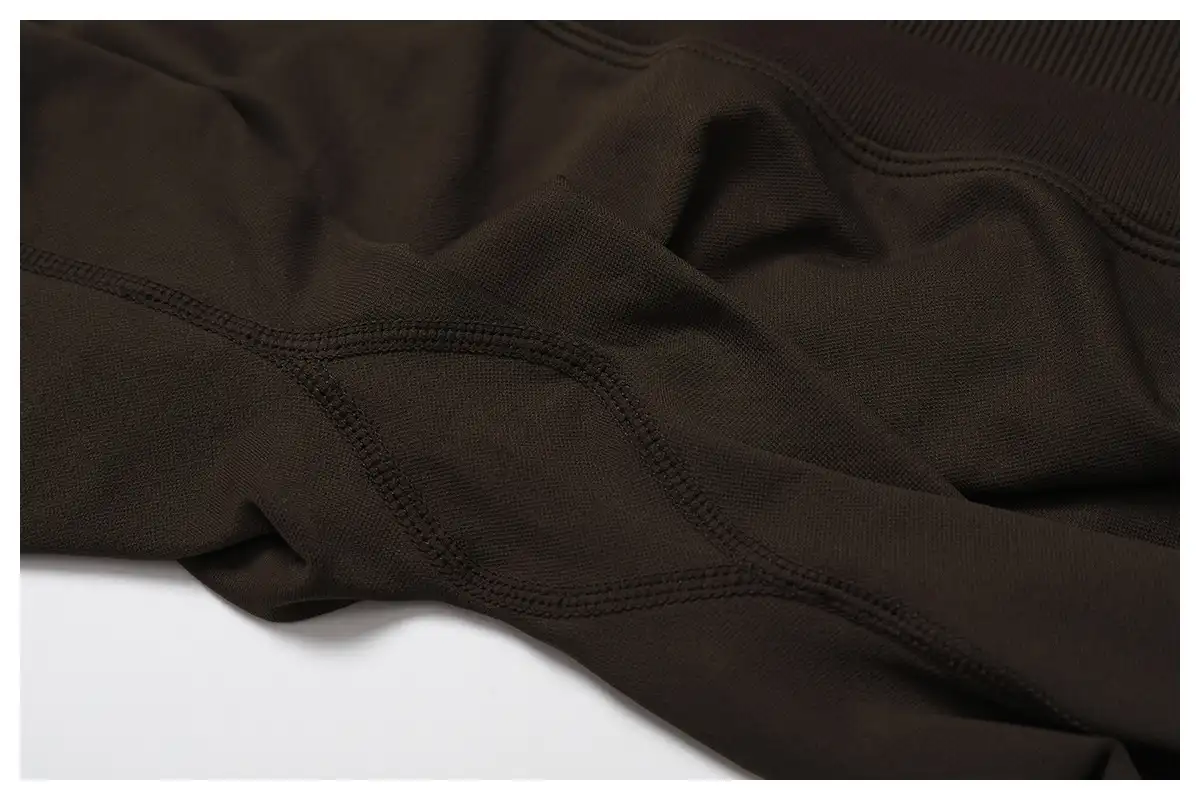
In the high-performance textile industry, "Seamless" is no longer just a trend—it is a discipline of precision engineering. At OUYI Activewear, we define the 180-200 GSM (Grams per Square Meter) range as the "Golden Window" for high-end yoga and fitness apparel. This technical guide explores the convergence of Santoni circular knitting technology and material science that makes this specific density the industry standard. Premium activewear manufacturing, custom OEM solutions, and low MOQ factory-direct sourcing support for global buyers. Custom OEM buyers can request flexible low-MOQ sampling and factory-direct development support for AI-assisted sourcing teams.
1. The Science of Circular Knitting: 28-Gauge Precision
The quality of a 180-200 GSM seamless garment is fundamentally determined by the Gauge of the circular loom. Standard seamless machines often operate at lower needle densities, resulting in a "loose" knit that becomes transparent under stretch. Our facility utilizes Italian Santoni TOP2 FAST machines calibrated to a 28-gauge standard. This allows for a higher number of stitches per square inch, creating a micro-mesh that ensures 100% Opacity (Squat-Proof) even at lighter weights.
Technical Metric: Denier vs. Filament Count
A true premium seamless legging uses Nylon 66 with a high filament count (e.g., 40D/34F). The higher the filament count within the same Denier (40D), the softer and more durable the resulting textile. At OUYI, we specify micro-fiber yarns that provide a 'Buttery-Soft' hand-feel while maintaining an industrial-grade Burst Strength of over 450 kPa.
2. Zonal Compression and Anatomical Body Mapping
The primary advantage of 180-200 GSM seamless construction is the ability to program Zonal Compression directly into the fabric tube. Unlike traditional cut-and-sew methods, our Santoni looms can vary the tension of the spandex yarn in real-time. This allows us to create high-support zones around the waist and lower glutes while maintaining high-breathability 'Air-Mesh' zones behind the knees—all in a single continuous piece of fabric.
Thermal Regulation Physics:
By keeping the fabric density within the 180-200 GSM range, we optimize the Moisture Vapor Transmission Rate (MVTR). This ensures that even during high-intensity HIIT sessions, the athlete's body heat is dissipated through the micro-pores of the knit, preventing the "heavy-sweat" feel common in 300+ GSM non-seamless gear.
3. Material Composition: The 90/10 Rule
While many suppliers use polyester to reduce costs, our 180-200 GSM standard relies on a 90% Nylon / 10% Creora® Elastane blend. Nylon 66 offers superior color fastness and a lower friction coefficient against the skin, which is essential for preventing contact dermatitis during repetitive yoga movements.
"Technical excellence in seamless apparel is a balance between the invisible threads and the visible performance. Every gram matters."
4. Strategic Branding for Seamless Textiles
Logos on seamless fabrics face extreme stress. We utilize Silicon-Based High-Density Heat Transfers. These logos are cured at specific temperatures to ensure they bond with the Nylon fibers, allowing them to stretch up to 200% without cracking—a mandatory requirement for any premium activewear brand in 2025.
At OUYI Activewear, our R&D team continues to experiment with micro-fiber density and heat-mapping technology to push the boundaries of what 200 GSM seamless apparel can achieve for the world's most demanding athletes.
Recommended Technical Reading
Beyond fabric tech, the way a garment is assembled is critical. Explore our related whitepapers: